Tuesday, October 29, 2019

Two More Mouths to Feed

(originally published March 14, 2013)

Well, it's been almost a month and I haven't made any progress on the frames I mentioned in my last blog post, but I did make the mouths for them just so I could report some progress. The mouth is actually a pretty easy part to make and only requires an hour or so. It is a fun area to work on though because it requires a little more skill and challenge than just binding bamboo together.

You get to feel like a lumberjack splitting wood! Well, maybe not quite, but you do start with a strip of bamboo twice the width of a standard framing strip and end up splitting each end into two legs. This makes the mouth base a unified piece while allowing the shape to be more complex than it otherwise could be. One set of legs gets turned into the main curve of the mouth shape and the other set becomes the "wings" on either side.

And you get to play with fire! Knives and fire and building lions?!? Yay! Can this project have any more of my favorite things? (Note: please use all of the aforementioned things responsibly, I am not liable for any injuries if you try this at home.) Getting the right angle for the corner of the mouth requires softening up the bamboo to make it pliable enough to bend like that. Heating it up with a small candle flame is the perfect solution to do just that. Even with the use of heat, bend it slowly and carefully being sure not to break the bamboo or else the whole piece will be ruined. Also be sure to keep the piece moving around when bringing it close to the flame to keep it from catching on fire. A little scorching is normal and won't affect the strength of the corner too much.


Add a few more pieces, then wrap the corners with rattan, and voila! There you have a brand new mouth, all ready for papering, painting and decorating. This probably feels like those cooking shows that show you all of the ingredients and then pull a fully-cooked dish out of the oven. I had planned on photographing each step but then I got caught up in the building process and forgot all about it. Next thing you know I'm looking at two fully completed mouths and only have pictures of the beginning steps of one of them. Sorry about that. Hopefully it's enough for you to understand the process and gives you a good idea for how to proceed with your own project.

Thanks for tuning in, if you're interested in more detailed instructions, including a full set of measurements and illustrated diagrams, check out the soon-to-be-released Lion Construction Manual! I'm working hard to get it done by Chinese New Year, 2014 (January 31) and building these two little lions at the same time. Wish me luck!

Are you working on a lion or dragon project of your own? I'd love to talk shop and see what others are doing, drop me a comment below and let me know what you're up to, thanks!

Back in a Bind Again

(originally published February 26, 2013)

The lion dance is in my blood so even though I'm on sabbatical from performing I've still got a lot of projects to keep me busy and involved in the community. Since I am a family man as well, building lions for my kids is the perfect way to combine two of the most important things in my life. Unfortunately having kids leaves little time for lion building so even though I plan the projects out, actually getting them done is a really long process with huge gaps of time interrupting progress on them.

For instance, my first son was born almost 10 years ago and it took me over 2 years to build his lion. You can read more about it and see some close-up shots here.

By the time I finished that lion it was almost time for my daughter to be born and I started on her lion. And what you see here is still how it looks today. That's seven years worth of work you're looking at, baby.

Fast forward a few more years and number 2 son was on his way into the world. I was working on the Lo On Kee restoration at the time so I didn't actually start building his before birth like the other kids', but I did buy some supplies and start to plan it out. That was a year and a half ago and what you see over there is how far I've gotten since finishing the restoration about a year ago. Most of that amazing progress has happened in the past few days.

So now that I've cleared some other projects off of my schedule I'm ready to buckle down and start working on these two frames again! It feels good to dust off the work bench and start bending and binding again. As with my first son's lion you can see I'm using aluminum for the base and main framing sections of the lion. Kids aren't exactly known for being careful with their things so I figured some extra strong material was in order for their lions. What I learn about using different materials for their frames can be applied to building stronger and better full-sized lions as well.

The reverse is also true, what I learned restoring the Lo On Kee lion has helped me advance in skill and understanding and will definitely come in handy with these two builds. My plan is to start to get the ball rolling but still keep a realistic time frame considering my other obligations. Getting the frames done by the end of the year would be great and hopefully not too lofty of a goal. I'll keep my progress posted here, keep checking back if you're interested, thanks!

Let me know what you think by commenting below, I appreciate it!

Positively Glowing

(originally published January 11, 2013)

As we begin 2013 in the West, the Year of the Water Snake (4711) is rapidly approaching. Along with that will be lots of lion dance performances, including many at night or in other low-light conditions. So how do you make sure your lions are ready? By installing lights of course!

"Bright eyes" is a common expression to describe someone full of life and that's exactly the image we want lions to portray. In Chinese one term for the Southern Lion is "Sing Si" or "Awakened Lion" so anything that helps the lion look awake and alert is a good thing. Lights in the eyes really bring attention to the lions, especially in a darkened room or at an evening performance outdoors.

Here's a shot of the original setup to light the lion's eyes. You can see it was fitted with standard flashlight incandescant bulbs which would be hooked up to a switch and several batteries.

At the time the lion was originally built this was a great solution and worked well for many years. However there were several drawbacks to using it. The main one is that incandescant bulbs tend to use a lot of power so we would drain several sets of batteries over the course of our New Years performances. I remember our group coordinators getting after us to, "Remember to turn off the lights!" after every performance. You could always add more batteries or use a larger size (we had lions that used everything from AA to a couple of D cell batteries) but this would add significant weight to the lions.

For the restoration I wanted to keep the weight down as much as possible. After researching online and asking other experienced people on the Lion Dance Forum I came up with a design I believe is one of the best in use today in terms of weight, light output, ease of installing and durability. I went with LED lights which use energy much more efficiently and reflective chrome lamp holders. Because of the greater energy efficiency and higher reflectivity I could get away with a minimal number and smaller sized batteries while actually over doubling the amount of light output compared to the original lights. To keep the bulbs from burning out prematurely each bulb is protected by an electrical resistor to regulate the current flowing through them.

Since installing them and showing them off I've actually gotten requests to build and sell light sets to other groups and have sold a dozen or so. I never thought there was much of a market for things like this, but what a nice confirmation that the work I put into researching, designing and building them is recognized and appreciated by others and also that my work is going on to help other groups as they help spread the art.

I'm watching you!

Here's the final result. What do you think? Feel free to comment below, thanks!

Reunited and it Feels So Good

(originally published July 12, 2012)

A private collector from Southern California expressed interest in the tail and he had a traditional Liu Bei head that it would match well with it so I met up with him and a friend one Sunday afternoon.

As we unpacked the tail and spread it out for them to inspect we talked shop about different tails we've seen over the years and compared similarities and differences with this tail. The head he had matched colors nearly perfectly as you can see in these shots of the front and back.

Although I'll miss the tail I'm glad to know that it's part of a whole lion once again, and even better it'll be used in actual performances, not just stuck collecting dust in a museum or stuffed in a box forgotten somewhere. What a great ending to this tail's story!

Chasing a Tail

(originally published July 3, 2012)


As I was browsing eBay for interesting things I came across a listing for a "~~CHINESE Ancient Art RARE Handmade Ceremonial Pagent Satin LION DANCING ROBE~~" and lo and behold the picture wasn't of a robe at all but a vintage tail for a Liu Bei lion. From the pictures it appeared to be in great condition, especially considering its age. The description was a bit odd, but I was intrigued--what was the story of this tail? Where was the head? What group did it come from? What maker? So I contacted the lister to find out what I could.

The lister had bought it at an auction and only knew that it came from a group who had used it in the Seattle Seafair Parade (now known as the Alaska Airlines Torchlight Parade) so that really didn't tell me much. My passion for lion restoration was ignited however and I began to wonder about the possibility of reuniting this tail with an old head so it could be properly seen as it was meant to be.

I knew of several lion heads on display in museums around the country that are displayed without tails: (none of these pictures were taken by me):
This lion is in the collection of the Wing Luke Museum in Seattle. 

This lion was rescued from a trash bin in Los Angeles' Chinatown.

A rare traditional Hok San lion made by Lo On Kee.

This lion is currently on display at the Chinese Historical Museum in San Diego.

The asking price of $299 was out of my league though, especially for a tail without a head and considering that a majority of the craftsmanship and value is in the head not the tail. Luckily the lister was open to bargaining and I was able to purchase it for less.

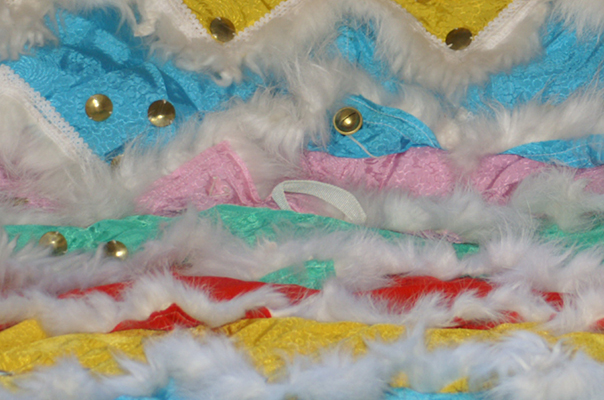
When the package arrived and I was able to inspect it further I found it was in great condition, almost appearing unused. There was no staining, even on the white undercloth where the tail player's sweat usually leaves tell-tale black marks and on the white rabbit fur along the bottom edges that are among the first areas to soil. On a close inspection I ohnly found one are that was slightly tattered, one small metal disc missing and a couple of metal discs that were bent. Other than that everything was intact. One sort of disappointing thing was the description listed it as 15 feet long which would make it really traditional and probably pre 1960s, but when I measured it came out to only 10 feet which was more common from the 70s to 80s. I think the lister didn't know how to measure it and included the back part that drapes down in her calculation. You could also tell the tail had been in storage for a while because of the wrinkles and how some of the triangles didn't lay flat anymore due to the way it had been folded.

There were also some other interesting things I noticed:

All of the discs are gold color, instead of the more common silver used today. The three large discs on the top pink layer were not evenly spaced, I'm not sure if it was meant to be like that or if one fell off and was sewn back on in the wrong place. A series of nylon web loops were sewn down the back of the lion. Obviously a much later addition, it looked like something put on to attach the tail to a pole or tie strings on to hang it for display. On the bottom there were ties sewn in directly under the loops and some additional pieces of nylon webbing. Very curious what these were added for. Under every other triangle brass bells were sewn in. These are usually missing from modern tails but were an important part of the lion's ability to frighten away evil as the sound of bells are said to scatter the spirtis.

All in all it was a rare find and it was great to see it up close and personal. Many lion dancers these days have never gotten to see a tail like this and it brought back may good memories of dancing under the long traditional tails. Hopefully soon I'll be able to post some pictures of it reunited with an old head and people can really see what things looked like "back in the day."

Who's in the House? Zhang Fei's in the House! Well, I'm pretty sure it's him…

(originally published May 30, 2012)

Recently this picture showed up online in a group I participate in on Facebook and it sparked a lively little debate. The original poster was wondering who (which historical general, if any) the lion represented and the answer, according to the lion maker, is Zhang Fei. This made a few people pause a bit because there is a lot of blue and not so much green used on the lion. What does that matter, you might ask. As I mentioned in a previous post, the colors of traditional lions are determined by the colors of the face paint of that general as portrayed in the Cantonese opera. For Zhang Fei this has always been black and white (and/or gray) with black hair and beard. Touches of green are often used as accents.

Here are some examples (all were found online, none of these pictures were taken by me):


As you can see from the other pictures above there is a lot of room for variation even when using the original color scheme. So without a compelling reason to deviate from the tradition, it would be unnecessary to change the overall color pallette for traditional lions. There is even precedent on the Zhang Fei lions to use blue (usually on the eyelids) sparingly as a supporting color, but not a main color.

Although the first picture above is what sparked the debate, it really isn't just about that lion.

At the heart of the debate are questions about the evolution of traditions and the validity of artistic license. Art forms are constantly changing and subject to reinterpretation according to the visions of individual artists. At the same time if there are no overarching guidelines then the results are often unrecognizable bastardizations of the originals. How many times have we sat through a horrible remake of a classic film that completely missed the mark of the original?

So what place do ancient traditions play in modern society? How do we as artists express our individuality while still remaining true to the customs that have been handed down through the generations? Can we disregard the teachings of our lineage and claim artistic differences? Are modern aesthetics more important than historical precedents? These are not easy questions to answer and there are no clear cut lines dividing the camps.

For me, as a performing artist, there are at least two major criteria I would use before changing a standing tradition. 1) Is there a compelling reason for the tradition that would be violated by the change? And 2) Would the intended audience still understand what is being conveyed?

Like it or not, traditions started and became ingrained for a reason; sometimes a good reason, sometimes a more questionable one. Arbitrary, superstitious and no longer relevant practices can be disregarded as we pare an art form down to its essentials. For example the Chinese tradition that says women shouldn't bathe for a week after giving birth was most likely started at a time when river water posed a greater threat of parasites and other illnesses than not bathing. We've luckily advanced as a society to where we can end this practice. We always want to make sure we aren't just blindly holding onto the past without basis. However we also have to recognize that there might be a reason we are not aware of. We need to do our due diligence and consult with others who can give guidance on this rather than just trusting our own, often limited, judgment.

As for the second criterion, the whole reason we perform is not for ourselves but for the audience, whether that's a merchant that's hired our team to bless their business, a couple celebrating their marriage, or the viewers at an exhibition performance. An actor could give the most inspired performance in the history of the stage, but if there is a disconnect with the audience it will all be in vain. So as performers we want to make sure every aspect of our presentation gets our intended message across. In terms of the lion dance, there are several things that a knowledgeable audience would expect to see. As a specific example, let's apply these to the lion pictured above. What are the reasons for the traditional colors of Zhang Fei? Black hair and beard to signify his youth, and black markings on his face to portray his dark complexion. In the Cantonese Opera, each of the Five Tiger Generals was assigned his own color(s) to differentiate him from other characters and make him consistently and easily recognizable even among different acting troops and from play to play. Every actor/troop could apply the makeup in their own style, but all used the same color schemes. Major deviations were liable to cause confusion among an often illiterate audience who relied on visual cues to follow the action.

But is this outdated? Would a modern audience know enough to recognize Zhang Fei in a slightly different color scheme? Given the right context, i.e. sitting next to the other 4 Tiger Generals, an informed audience would probably be able to figure out who was who. Also, given that many people don't know enough about the lions or the generals they represent beyond the main three (Liu Bei, Guan Gung and Zhang Fei) by process of elimination most would probably guess that this was Zhang Fei anyway. But if it appears by itself and even people in the know need to ask who it is supposed to represent, it might indicate that the artist should have stuck a little closer to tradition.

So the jury is still out. Personally I really like this lion. It has the fierce look of a traditional general and it has touches that make it stand out from the usual slew of lions. But whether or not I would consider it a good representation of Zhang Fei is debatable.

As a final bit of food for thought, here is a picture of an opera troop portraying Zhang Fei with a blue headdress:


Want to weigh in on the issue? Feel free to comment below, I'd love to hear your thoughts!

Lion Under Glass

(originally published February 24, 2012)


Nestled in the Asian/Pacific Thematic Historic District of San Diego's Gaslamp Quarter is a great little museum. The Chinese Historical Museum is comprised of two buildings on opposite corners of Third and J. The original building used to be a mission building built in the 1920s to be an outreach and community center to the Chinese in San Diego at the time. Behind this building is a small Asian garden and fish pond.

Across the street the rotating exhibits are housed in the Dr. Sun Yat-Sen Memorial Extension. Just in time for the Chinese New Year (February 23 this year) a new exhibit opened featuring traditional new year prints, a small collection of tiger hats, a performance dragon, and a late entry to the lineup: the restored lion.

The curator, Alex Chuang, was kind enough to allow me to display the lion and as we emailed back and forth about the details the plan grew until I had to borrow a minivan to take all of the components down south. I'm glad Alex had the foresight to ask probing questions about how to go from, "Hi, I have something people might like to see" to a real museum-quality display.

Between the Hoi Gung ceremony and the museum display there was only a week to prepare everything including deciding what to display, how to arrange it, and all the signs to create. Good thing my wife and I love a challenge and work well under pressure.

So, here's what we came up with. Let me know what you think and if you get a chance, go see it in person. Pictures just don't convey the same scope as seeing it in real life.

Click any picture for a larger version.
It was fun trying to come up with a way to fit everything into the space requirement without it looking crowded. I was also trying to come up with some sort of order so the display would take the viewers through a logical progression of the project.

Coming up with signage that would be interesting to both lion dancers who know their stuff and the general public was a bit of a challenge. Good thing my wife is an excellent editor! Figuring out where to place each sign in the display presented other issues as well.

I also decided to reuse the poster we made for the Beyond the Pride exhibit. Even though it says, "There's still more work to be done" in big red letters on the bottom, it gives a good background on the project and has a lot of information on the process so I thought it'd still be relevant. Besides it'd be a shame to have made a poster like that only to be used once!

I recruited my kids to help arrange the displays so setting them up at the museum was a real family affair. The "Littlest Petshop" toys didn't actually make the cut for the final display, but my daughter thought she'd bring them along anyway.

The main display case is right at the entrance to the exhibit so you can't miss it. The frame in the second case is also from an old Lo On Kee lion around the same age as the restored one. Eventually it will also go through the restoration process.

The third case has a collection of parts showing the variety of pieces that make up a lion. Parts from a variety of lions and makers were chosen from my collection to show the similarities and differences.

One of the best comments I've gotten is from the museum staff who said that many people don't bother to read the signs on display pieces, but so far everyone has taken the time to read mine. Guess all the time and effort my wife and I put into them was worth it! Read on and let me know what you think.


Here are a couple of the other items on display:

There are a few signs that I didn't get good pictures of so if you want to read them all you'll have to go visit America's finest city and spend the $2 for admission to the museum. The rest of the exhibits are more than worth the price.

After this exhibit closes some other venues might be interested in displaying it down the line (details will be posted here if anything works out), but I don't have any set plans. If you know of a location or event that would be interested in showing it feel free to let me know.